
You’ve stretched, you’ve rested, and you’ve tried massage. But the tightness keeps coming back. For many people, the missing piece isn’t more treatment — it’s a different kind. Myofascial release targets something that standard massage doesn’t directly address: the fascia, the connective tissue that wraps around every muscle, bone, and organ in your body.
This article explains what myofascial release actually is, how it differs from regular massage, and how to know whether it’s the right approach for what you’re dealing with.
What Is Fascia — And Why Does It Matter?
Fascia is a web of connective tissue that runs throughout the entire body. It surrounds and supports muscles, separates structures, and connects regions that seem unrelated. Healthy fascia is pliable, hydrated, and allows structures to glide past each other smoothly. When it’s healthy, you don’t notice it.
However, fascia responds to injury, poor posture, repetitive strain, and stress by thickening and tightening. These restrictions don’t show up on X-rays or MRIs. Because of this, they’re often missed in standard diagnostic workups. But they’re very real — and they can generate significant pain, stiffness, and reduced range of motion.
One important feature of fascia is its interconnected nature. A restriction in the plantar fascia of your foot can create tension up the calf, into the hamstring, and eventually affect your lower back. Because of this, myofascial release doesn’t always work directly at the site of pain — it works at the source of the restriction, which may be elsewhere in the body.
What Is Myofascial Release Therapy?
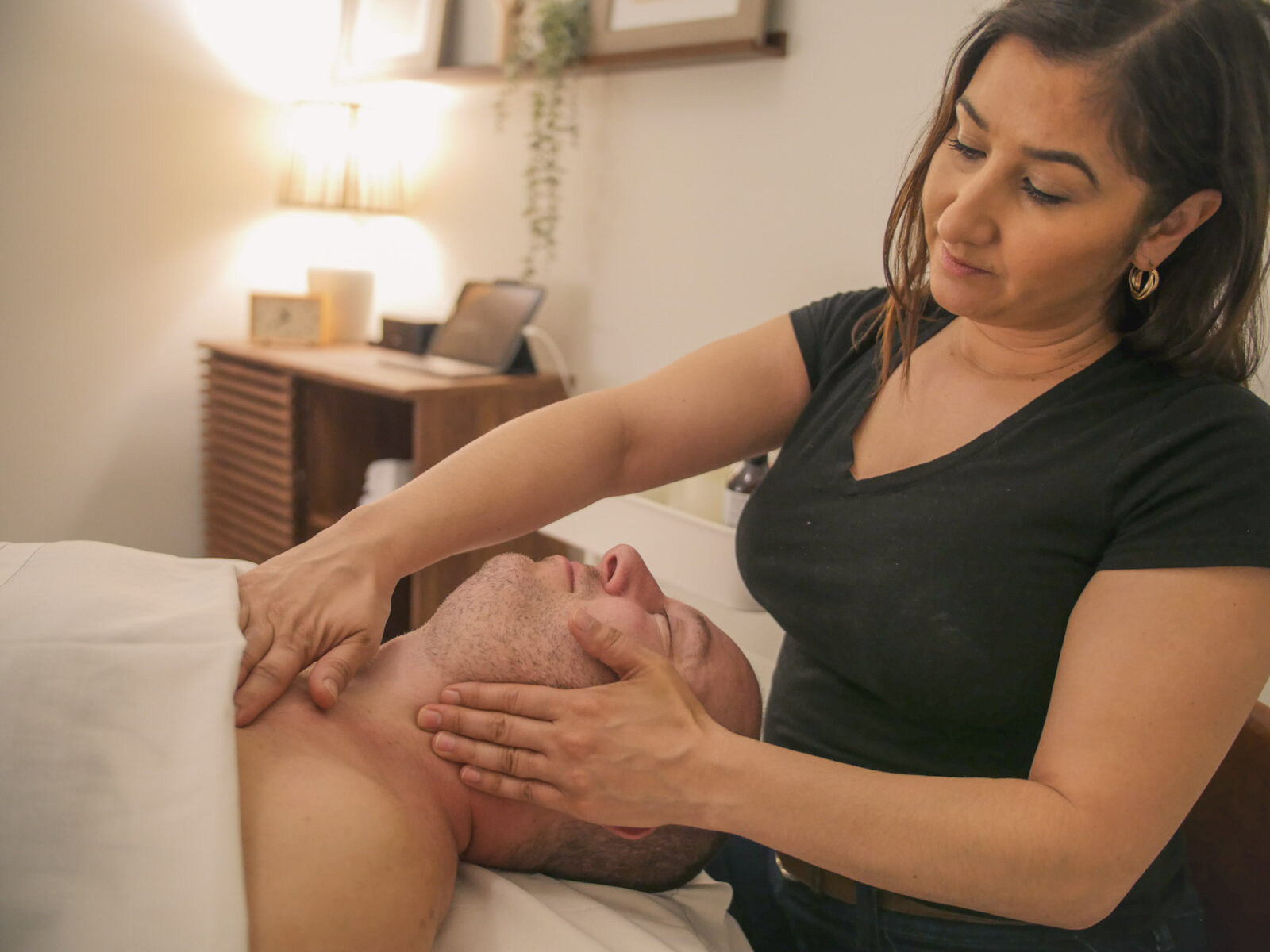
Myofascial release is a hands-on treatment technique that uses slow, sustained pressure to stretch and release fascial restrictions. Unlike deep tissue massage, which works primarily on muscle bellies, myofascial release targets the fascial tissue itself. Techniques are typically performed with minimal oil or lotion so the therapist can feel the tissue response accurately.
The sensation is different from standard massage. Rather than the gliding strokes of a relaxation treatment, myofascial release feels more like a slow, deliberate skin stretch. Most clients find it deeply grounding — and many notice a release of tension that extends well beyond the area being treated.
At Myocare, myofascial release is offered as a standalone treatment or integrated into a broader massage session. Our Myofascial Release specialists — including Adriana Petrik, Kenny Karst, Tyler Ruebottom, and Suzanne Carson — all hold RMT designations and have specific training in fascial work.
How Does Myofascial Release Work?
The mechanism behind myofascial release is both mechanical and neurological. On the mechanical side, sustained pressure applied to restricted fascia gradually overcomes the resistance of the thickened tissue. Fascia has viscoelastic properties — meaning it softens and lengthens under prolonged, low-load stretch, in a way it won’t under brief or forceful pressure.
On the neurological side, sustained pressure activates mechanoreceptors in the fascial tissue. These receptors signal the nervous system to reduce local muscle tone and allow the tissue to release. This is why myofascial release is performed slowly. Speed undermines both mechanisms. A rushed technique produces a guarding response rather than a release.
The result is improved tissue mobility, reduced pain, and better range of motion — often felt immediately after treatment and continuing to improve in the days that follow.
What Conditions Does Myofascial Release Help With?
Myofascial release is effective across a wide range of conditions. It is particularly valuable when standard massage or physiotherapy has provided partial relief but not resolved the underlying issue. Common presentations our RMTs treat with myofascial techniques include:
Condition | How Myofascial Release Helps |
Chronic low back pain | Releases lumbar and thoracolumbar fascial restrictions that perpetuate pain cycles regardless of muscle treatment |
Neck and shoulder tightness | Addresses the cervical fascia and upper trapezius region that standard massage treats superficially |
Tension headaches | Reduces fascial tension in the suboccipital and cervical regions that refers pain to the head |
IT band syndrome | Releases the lateral fascial line contributing to knee and hip pain in runners and cyclists |
Plantar fasciitis | Directly treats the thickened plantar fascia and the broader fascial chain driving the restriction |
Post-surgical scar tissue | Mobilizes adhesions that form following surgery or significant injury, restoring movement and reducing drag |
Fibromyalgia | Addresses widespread fascial hypersensitivity and restriction patterns common in fibromyalgia presentations |
Postural strain | Releases the fascial patterns that hold the body in compensated postures, allowing realignment |
TMJ dysfunction | Works on the fascial structures of the jaw, face, and cervical spine contributing to jaw pain and clicking |
Myofascial Release vs. Deep Tissue Massage: What’s the Difference?
This is one of the most common questions we get. Both techniques work on soft tissue, but they target different structures and use very different approaches. Understanding the distinction helps you book the right treatment.
| Myofascial Release | Deep Tissue Massage |
Primary target | Fascia (connective tissue) | Muscle belly and soft tissue |
Pressure style | Slow, sustained, low-load | Firm, directional, variable speed |
Lubricant used? | Minimal or none — requires skin grip | Yes — oil or lotion applied |
Best for | Chronic restriction, scar tissue, recurring pain despite other treatment | Acute muscle tension, sports recovery, general tightness |
What Does a Myofascial Release Session at Myocare Look Like?
Each session begins with a brief assessment. Your RMT will observe your posture, ask about your history and current symptoms, and palpate areas of concern before treatment begins. This isn’t a formality — fascial restrictions often refer pain to areas distant from their source, so understanding your full pattern matters before starting.
During Treatment
Techniques are applied with minimal or no lotion so the therapist can accurately feel the fascial tissue. You’ll notice the pressure is slow and deliberate — your therapist will hold a position until they feel the tissue begin to soften and release, then follow it further. Sessions typically run 60 to 90 minutes, depending on the extent and complexity of the restrictions.
Most clients describe the sensation as a deep, satisfying stretch rather than pain. Some areas may feel more sensitive than others — this is normal and indicates the tissue is responding. Your RMT will check in throughout and adjust based on your feedback.
After Treatment
It’s common to feel lighter and more mobile immediately after a session. Some clients experience mild soreness in the 24 to 48 hours following treatment, particularly if significant restrictions were addressed. Drinking water and doing light movement helps the tissue continue to respond. Your RMT may give you simple exercises or stretches to maintain progress between sessions.
The number of sessions needed depends on how long restrictions have been present and how widespread they are. Some clients notice dramatic improvement after one session. Others with chronic or complex presentations benefit from a short series of treatments.
Myofascial Stretching: What You Can Do Between Sessions
Active myofascial stretching between sessions supports the work done in treatment. However, myofascial stretching differs from standard static stretching. Because fascia responds to sustained, low-load input — not brief or ballistic movement — the key principle is: hold longer, go gentler.
Effective myofascial stretching holds positions for 90 seconds to two minutes, well past the point where a standard stretch would be released. The goal is to allow the fascial tissue time to soften and lengthen, rather than just stretching the muscle. Your RMT will recommend specific patterns based on your restriction profile — generic stretching routines are less effective because they don’t account for where your fascia is actually restricted.
How to Know If Myofascial Release Is Right for You
Myofascial release tends to produce the best results when:
• You have chronic tightness or pain that returns despite regular massage or physiotherapy
• You’ve been told your muscles are ‘always tight’ but the cause isn’t clear
• You have pain that seems to move or refers to areas away from where you’d expect
• You’re recovering from surgery and experiencing restricted movement or pulling sensation from scar tissue
• You have a postural pattern that isn’t improving with exercise alone
• You’re managing a condition like fibromyalgia or chronic fatigue where widespread sensitivity is present
If you’re unsure whether myofascial release or another treatment is the better starting point, our Registered Massage Therapists are happy to discuss your presentation before you book. You can also review the team’s individual specializations on our Practitioners page.
Frequently Asked Questions
Is myofascial release the same as a regular massage?
No. Regular massage works primarily on muscle tissue using gliding strokes with oil or lotion. Myofascial release targets the fascial layer using slow, sustained pressure with minimal lubricant. The technique, sensation, and intended outcome are all different — though both can be valuable depending on what you’re dealing with.
What does ‘micro fascial release’ mean?
Micro fascial release refers to more localized, precise fascial work — typically applied to smaller or deeper areas of restriction rather than broad regional techniques. It uses the same sustained-pressure principle but with more targeted contact points. Some practitioners use it specifically for areas like the face, jaw, and suboccipital region.
How many sessions will I need?
This depends on how long restrictions have been present and how complex the pattern is. Some clients feel significant relief after one session. Chronic or widespread restrictions typically respond best to a short series — often three to six sessions — with reassessment after each one. Your RMT will give you an honest recommendation based on what they find.
Does myofascial release hurt?
It shouldn’t be painful. You may feel a deep stretch or mild intensity as a restriction releases, but discomfort that makes you brace or hold your breath means the pressure is too much. A good myofascial release session involves working at the edge of comfortable sensation, not beyond it. The tissue releases more effectively when you’re relaxed — not guarding.
Is it covered by insurance?
Yes, when performed by a Registered Massage Therapist. In Ontario, extended health benefits typically cover RMT treatment regardless of the specific technique used. Myocare offers direct billing to most major insurers. Check your plan’s annual RMT benefit limit.
Can myofascial release help with sports injuries?
Yes — and it’s often most effective when combined with sports massage as part of a broader rehabilitation plan. Fascial adhesions often form around injury sites and can limit recovery even after the original tissue has healed. Addressing the fascial component helps restore full range of motion and reduce re-injury risk.
Book a Myofascial Release Session in Toronto
Myocare RMT & Wellness is located at 1096 Bathurst Street in the Annex. Our myofascial release specialists — including Adriana Petrik, Kenny Karst, Tyler Ruebottom, and Suzanne Carson — are available for bookings Monday through Sunday. Visit our Myofascial Release page for rates and details, or book directly online. Questions? Call (416) 995-6601