
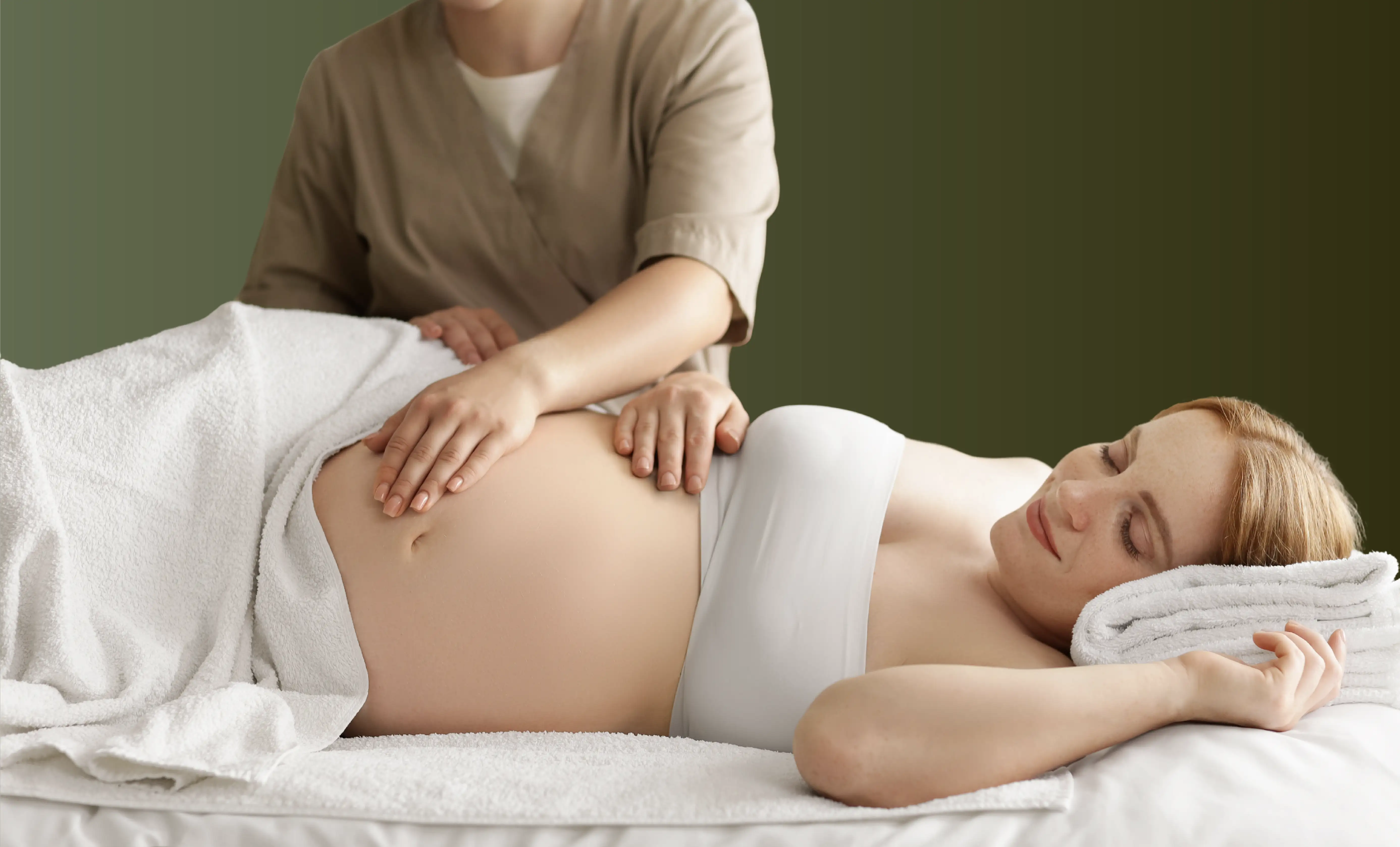
Pregnancy reshapes everything — your posture, your sleep, your nervous system, and your relationship with your own body. It makes sense that many people turn to massage therapy for relief. But the question we hear most often at our Toronto clinic is a reasonable one: can you get a massage while pregnant?
The answer is yes — with the right training, positioning, and intake process, prenatal massage is safe throughout all three trimesters. What changes is the approach. This guide explains exactly what that looks like, trimester by trimester, and what to look for in a qualified provider.
Is Prenatal Massage Safe?
Yes. Prenatal massage is safe when performed by a Registered Massage Therapist (RMT) with specific training in pregnancy care. In Ontario, RMTs are regulated health professionals — not spa practitioners — and are trained to adapt technique based on your gestational stage, health history, and presenting symptoms.
Massage during pregnancy is meaningfully different from a standard session. A trained RMT will adjust:
- Positioning — side-lying with bolster support replaces prone lying after the first trimester
- Pressure depth — lighter work over certain areas, adjusted as pregnancy progresses
- Focus areas — hip flexors, glutes, QL, and thoracic spine are prioritized as your center of gravity shifts
- Technique selection — circulatory approaches that support venous return without overstimulating deep tissue
At Myocare, every prenatal session begins with a thorough health intake. Our RMTs — including specialists like Kenny Karst and Adriana Petrik, who collectively bring decades of prenatal massage experience — review your full history before treatment begins.
First Trimester Massage: Navigating Early Pregnancy
The first trimester is often the most variable stage for massage therapy. Many people experience significant fatigue, nausea, breast tenderness, and heightened emotional sensitivity — all of which are clinically relevant when designing a treatment.
Is massage safe in the first trimester?
Yes, but the approach is conservative. The physiological changes during weeks 1–13 are significant: progesterone and relaxin surge early, blood volume begins to increase, and fatigue can be profound. Some clinics elect to avoid deep work in the first trimester as a precautionary measure, particularly if a client has a history of early pregnancy loss or has been flagged as higher risk.
What a skilled first-trimester session typically includes:
- Gentle relaxation techniques focused on the back, neck, and shoulders
- Light myofascial work to address postural tension
- Breathing and parasympathetic nervous system support
- Avoidance of deep abdominal and strong circulatory work over the lower limbs
If you have any high-risk indicators — including prior miscarriage, subchorionic hematoma, or a multiple pregnancy — consult your OB or midwife before booking. Our RMTs are happy to coordinate directly with your care team if needed.
→ Learn more about our approach: Advanced Prenatal and Postnatal Massage at Myocare
Second Trimester: The Optimal Window for Prenatal Massage
For most people, the second trimester is the most comfortable period to begin or deepen a prenatal massage routine. Nausea typically subsides, energy returns, and the structural changes of pregnancy become more pronounced — which means the reasons to seek massage become more concrete.
Common complaints at this stage that massage therapy addresses directly:
- Low back pain and sacroiliac joint irritation as the lumbar curve shifts
- Hip and gluteal tightness driven by gait changes
- Sciatic nerve symptoms — often a referred pattern from piriformis or piriformis-adjacent structures
- Round ligament tension
- Early onset of leg swelling and heaviness
Second-trimester sessions typically use side-lying positioning with full bolster support. This is the stage when many of our clients establish a regular rhythm — every two to four weeks — that carries them into the third trimester.
→ See our Pregnancy Massage page for session details and rates.
Third Trimester Massage: Managing Weight, Swelling, and Sleep
In the third trimester, the body is carrying significant additional load. The lumbar spine and pelvis take on the most strain, and circulatory demands increase as blood volume peaks near term. Sleep disruption is nearly universal by this stage.
Third-trimester prenatal massage focuses on:
- Decompressing the lower back and sacrum, which carry the brunt of postural load
- Reducing edema in the lower limbs through gentle lymphatic techniques
- Softening the thoracic spine and rib cage, which can become restricted as the uterus rises
- Addressing shoulder and neck tension — often exacerbated by altered sleep positions
- Supporting relaxation and nervous system downregulation to improve sleep quality
What your RMT will avoid at this stage:
- Supine positioning — lying flat on the back can compress the vena cava and reduce cardiac return
- Deep abdominal work of any kind
- Aggressive trigger point therapy or intense deep-tissue pressure over the lower limbs
- Strong ankle and foot pressure over specific reflex points
Our clinic also offers Advanced Decongestive Lymphatic Treatments — a specialized approach that some clients find especially helpful in the third trimester for managing swelling.
What Techniques Are Modified or Avoided During Pregnancy?
The safest prenatal massage is not about what’s avoided — it’s about what’s adapted. A well-trained RMT will modify their approach rather than simply refusing to work on certain areas. That said, there are techniques and positions that are contraindicated or require clinical justification:
Consideration | Reason |
Supine positioning (after T1) | Risk of vena cava compression and reduced cardiac return |
Deep abdominal work | Avoids any unintended pressure on the uterus |
Intense lower limb deep tissue | Increased DVT risk during pregnancy requires more conservative circulatory work |
Strong ankle/foot reflex points | Some traditional points are modified as a precaution, especially pre-term |
When to Get Medical Clearance First
Prenatal massage is widely appropriate, but some conditions require clearance from your OB-GYN or midwife before proceeding. These include:
- Preeclampsia or pregnancy-induced hypertension
- Placenta previa or placental abruption
- Pre-term labour risk or incompetent cervix
- A history of blood clotting disorders or current DVT
- Sudden or unexplained edema — particularly if asymmetric
- Active vaginal bleeding
Our intake process flags these concerns and we will always recommend you consult your care provider if there’s any clinical ambiguity. We’d rather take the extra step than rush a treatment that isn’t appropriate yet.
What Are the Benefits of Prenatal Massage?
The research on massage during pregnancy has grown meaningfully over the past two decades. A 2004 study published in the Journal of Psychosomatic Obstetrics & Gynecology found that pregnant women who received regular massage showed reductions in anxiety, improved sleep, and lower cortisol levels compared to controls. [Verification note: cite original Tiffany Field et al. study if this page goes live — do not publish unchecked.]
Clinically, the benefits our clients report most often include:
- Significant reduction in low back and hip pain — particularly sciatica-pattern pain and sacroiliac discomfort
- Less leg cramping and ankle swelling, especially in the second and third trimesters
- Better sleep — largely driven by reduced musculoskeletal tension and nervous system calming
- Lower stress and anxiety levels, which have downstream benefits for fetal wellbeing
- Relief from headaches related to neck and shoulder tension
- Improved body awareness heading into labour
Massage therapy can also work alongside other modalities. Some of our clients combine prenatal massage with acupuncture or osteopathic manual treatment for more comprehensive support during pregnancy.
What About Postnatal Massage?
The recovery period after birth — whether vaginal or caesarean — presents its own set of physical demands. Postnatal massage helps address the postural patterns developed during pregnancy, supports recovery of the abdominal and pelvic floor region (with appropriate timing), and can be valuable for managing the physical strain of nursing and newborn care.
Our Advanced Prenatal and Postnatal Massage service covers the full continuum from early pregnancy through the postpartum period.
How to Choose a Qualified Prenatal Massage Therapist in Toronto
When you’re searching for maternity massage in Toronto, the credential that matters most is the RMT designation. In Ontario, Registered Massage Therapists are regulated by the College of Massage Therapists of Ontario (CMTO) and must meet defined educational and clinical standards. A spa aesthetician or wellness practitioner — however skilled — is not the same as a regulated health professional.
Beyond the RMT designation, look for:
- Documented training or continuing education in prenatal massage — not just ‘experience’
- A clinic that uses proper side-lying bolstering and adjustable equipment (not just pillow props)
- A health intake process that specifically screens for pregnancy-related contraindications
- Clear communication about what will and won’t be done in the session
At Myocare, several of our RMTs specialize specifically in pregnancy care. You can review their backgrounds on our Practitioners page — including Alexandra Whyte, Margot Mostyn (25+ years in practice), and Mitchell Degras.
We’re located at 1096 Bathurst Street in the Annex, with direct billing available to most major insurers. Many extended health plans cover RMT treatment — including prenatal massage.
Frequently Asked Questions
Can you get a massage while pregnant in the first trimester?
Yes, though the approach should be gentle and conservative. Most RMTs modify pressure, positioning, and technique significantly in the first trimester. If you have any high-risk factors or a history of early pregnancy loss, check with your healthcare provider first.
Is deep tissue massage safe during pregnancy?
Not as a general approach. Deep tissue techniques over the lower back, legs, and abdomen are modified or avoided during pregnancy. That said, moderate sustained pressure over appropriate areas — the glutes, thoracic spine, upper back — can be appropriate when applied by an experienced prenatal RMT.
How often should I get prenatal massage?
This varies by person and trimester. Many clients start with monthly sessions in the first trimester, move to bi-weekly in the second, and increase frequency in the third as discomfort intensifies. Your RMT will make a personalized recommendation based on your specific presentation.
Does my health insurance cover pregnancy massage in Toronto?
Most extended health benefits in Ontario cover massage therapy performed by an RMT — including prenatal massage. Myocare offers direct billing to many major insurers. Check your plan details or call us at (416) 995-6601.
What should I wear to a prenatal massage?
You’ll be comfortably draped throughout your session. Most clients undress to their level of comfort — you’re always covered except for the area being worked on. Side-lying positioning means you won’t need to remove clothing that would otherwise be difficult to work around.
When should I stop getting massages during pregnancy?
There’s no fixed cutoff. Many clients receive prenatal massage right up until their due date. In the final weeks, the session focus shifts toward comfort and relaxation, and your RMT will be especially attentive to positioning and pressure. If your pregnancy becomes high-risk at any point, defer to your medical provider’s guidance.
Book Your Prenatal Massage in Toronto
Myocare RMT & Wellness has been supporting Toronto clients through pregnancy since 2010. Our prenatal massage practitioners are Registered Massage Therapists with dedicated training in pregnancy care — not general wellness practitioners.
Ready to book? Visit our Pregnancy Massage page for full session details, or book directly online. Questions? Call us at (416) 995-6601 or visit us at 1096 Bathurst Street in the Annex.