
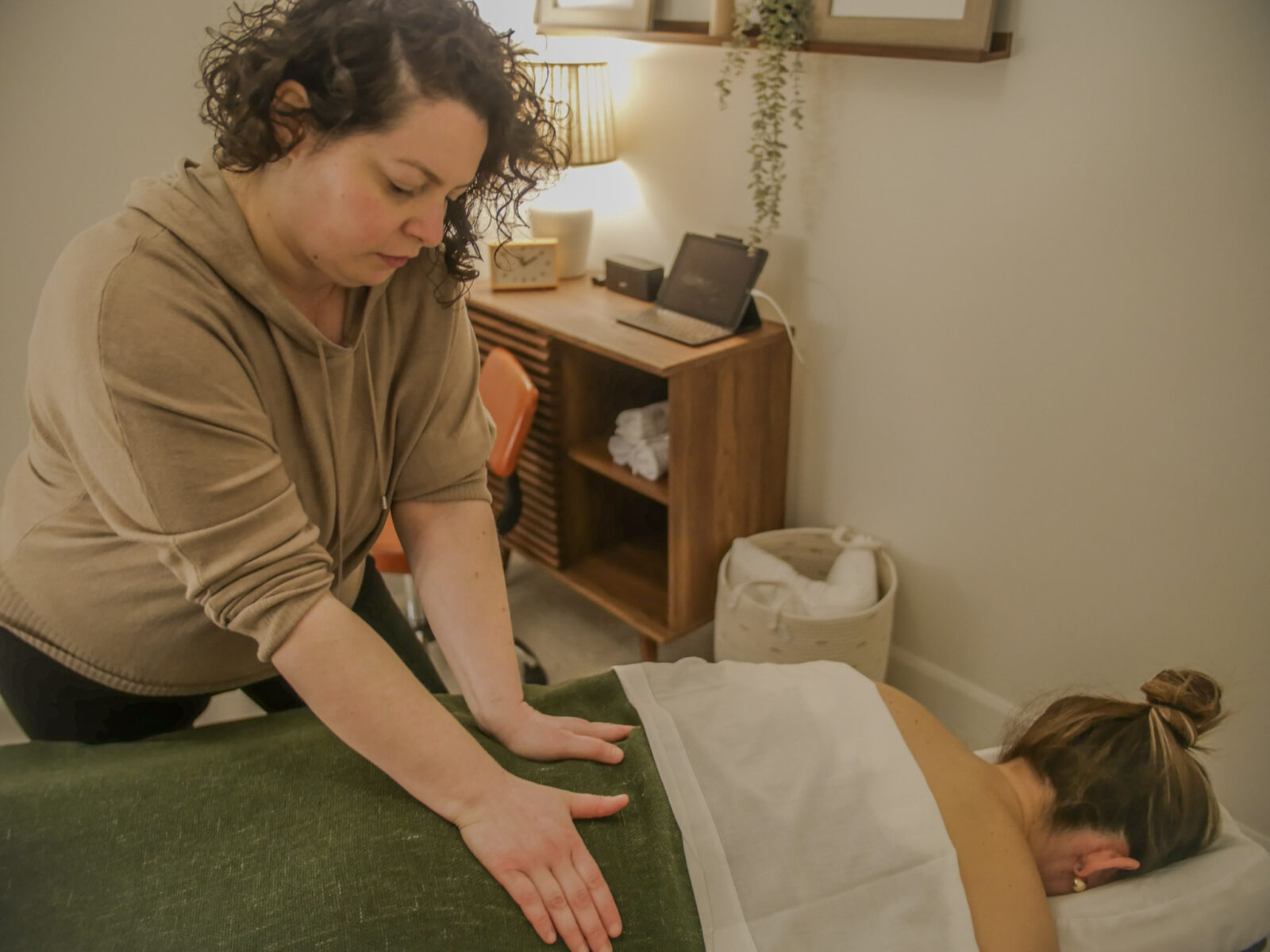
Sciatica is one of the most disruptive pain patterns a person can experience. Deep gluteal aching, a shooting or burning sensation down the back of the leg, and unpredictable flare-ups make it difficult to work, exercise, sleep, and move with confidence. Fortunately, sciatica massage therapy is one of the most effective conservative treatments available. Even so, it is often one of the last things people try, leaving many managing the condition for months or years unnecessarily.
Many people who visit our clinic for prenatal massage, myofascial release, or general back pain treatment have sciatica as either a primary or secondary complaint. This article explains what sciatica is, how sciatica massage therapy addresses it, and what to realistically expect from RMT treatment in Toronto.
What Is Sciatica?
Sciatica refers to pain that follows the course of the sciatic nerve. This nerve is the largest in the body. It runs from the nerve roots of L4, L5, S1, S2, and S3 in the lower lumbar and sacral spine, through the gluteal region, and down the back of the thigh to the lower leg and foot. Any pain that follows this path broadly qualifies as sciatica.
Two primary mechanisms cause sciatica, and they respond differently to treatment. The first is nerve root compression at the spine, typically from a herniated disc at L4/L5 or L5/S1. The second is peripheral compression of the sciatic nerve along its path through the posterior hip and gluteal region. In our clinic, this second mechanism is significantly more common.
The peripheral compression pattern most often involves the piriformis muscle or the surrounding deep hip rotators. Both presentations look identical in the early stages. As a result, a proper assessment before treatment matters enormously.
How Does Sciatica Massage Therapy Work?
Releasing the Piriformis and Deep Hip Rotators
The piriformis runs from the sacrum to the greater trochanter of the femur. In most people, it passes directly over the sciatic nerve. In roughly fifteen percent of the population, the nerve passes through the muscle itself. When the piriformis is chronically tight, it compresses the sciatic nerve directly. The resulting pain pattern closely resembles disc-related sciatica, but it responds much more readily to soft tissue treatment.
Targeted deep tissue release and trigger point therapy in the piriformis and surrounding deep hip rotators often produce rapid relief. In some cases, a single well-executed session produces immediate and significant symptom reduction.
This mechanism also explains the sciatic relief many of our prenatal clients experience. As the pelvis shifts during pregnancy, the posterior hip muscles carry significantly more load. Consequently, piriformis tension becomes one of the most consistent contributors to sciatica in pregnancy. You can read more in our prenatal massage safety guide and benefits of prenatal massage article.
Addressing the Gluteal and Lumbar Tissue
Chronic sciatica rarely involves just the piriformis. The gluteus medius and gluteus minimus often contain active trigger points that generate pain in the lateral hip, the SI joint region, and the upper gluteal area. Clinicians frequently mistake these trigger points for piriformis syndrome or SI joint dysfunction. Additionally, the quadratus lumborum drives lateral lumbar pain and SI joint compression. Our article on trigger point therapy explains how these sites are identified and treated.
Reducing Protective Muscle Guarding
When the sciatic nerve is irritated, the muscles around the hip and lower back go into protective spasm. This response limits movement and prevents further injury. However, it also compounds the problem over time. The spasm increases compression on the nerve, reduces blood flow to the area, and adds a secondary layer of muscular pain on top of the nerve irritation.
Sciatica massage therapy reduces this guarding directly. It activates the parasympathetic nervous system, lowers baseline muscle tone, and works through the superficial layers of contraction that hold the deeper restriction in place.
Supporting Disc-Related Presentations
Where sciatica originates from a lumbar disc herniation, massage therapy cannot treat the disc directly. However, it significantly reduces the muscular and fascial tension that accompanies disc-related sciatica. In many cases, this tension drives a large part of the symptom picture independently of the disc.
The lumbar muscles in disc-related sciatica typically hold severe protective spasm. Releasing this spasm lowers the compressive load on the disc and reduces mechanical irritation of the affected nerve root. It also creates the conditions the body needs to begin reabsorbing the herniated material, which it does in most cases given sufficient time.
What Does a Sciatica Massage Therapy Session Look Like?
Your RMT starts with a structured intake and movement assessment. They check your hip range of motion, lumbar mobility, the location and quality of your pain, and relevant orthopaedic tests that differentiate peripheral from central sciatica. This assessment directly determines how the session proceeds.
Treatment focuses on the posterior hip complex, the lumbar region, the sacral and SI joint area, and the muscles of the posterior thigh. Depending on what the assessment reveals, the session may also cover the thoracic spine, the hip flexors, and the hamstrings. Trigger point therapy and myofascial release are commonly part of sciatica treatment sessions. For disc-related presentations, the approach stays conservative and avoids techniques that increase intradiscal pressure.
Sciatica Massage Therapy in the Annex and Leaside
Myocare treats sciatica at two Toronto locations. Our Annex clinic at 1096 Bathurst Street serves clients across the Annex, Seaton Village, Palmerston, and midtown Toronto. Our Leaside clinic at 1517a Bayview Ave, East York serves clients in Leaside, Davisville, Moore Park, Thorncliffe Park, and the Bayview corridor.
Both locations deliver the same standard of clinical care. Our RMTs have significant experience treating posterior hip and sciatic presentations, including sciatica during pregnancy. You can review practitioner specialties on our meet our practitioners page. Book online or call our Leaside clinic at (416) 265-9606.
Frequently Asked Questions
Can massage make sciatica worse?
In some circumstances, yes. Deep work directly over an acutely inflamed nerve can increase local irritation and temporarily worsen symptoms. This is most likely during the acute phase of a disc-related flare, or when the piriformis or gluteal tissue is too inflamed to accept direct pressure. A well-trained RMT will assess the presentation carefully before starting treatment. If your sciatica is very acute, or if it comes with weakness, loss of bladder or bowel control, or progressive numbness, seek medical assessment before booking massage.
How many sessions will I need for sciatica?
Peripheral sciatica from piriformis or deep hip rotator tension often responds well in three to six sessions. Meaningful improvement typically starts in the first one or two. Disc-related presentations usually need a longer course of treatment, often alongside physiotherapy or medical management. Your RMT will give you a realistic expectation after your first session.
Should I see a physiotherapist or an RMT for sciatica?
Both can help, and they often work best together. Physiotherapy addresses the structural and rehabilitation aspects of sciatica, including core stabilisation and lumbar spine mechanics. RMT targets the soft tissue tension, trigger points, and fascial restriction that contribute to nerve compression. If your sciatica is disc-related and severe, see a doctor first. For more on what registered massage therapy involves, visit our RMT service page.
Is massage covered by insurance for sciatica treatment?
Yes. Most extended health benefit plans in Ontario cover RMT treatment regardless of the presenting complaint. Myocare offers direct billing at both our Annex and Leaside locations.
What can I do between sessions to manage sciatica?
Between sessions, gentle movement generally works better than complete rest. Prolonged sitting aggravates most sciatic presentations, so limit it where possible. Walking, gentle hip mobility work, and avoiding positions that compress the posterior hip are all helpful. Your RMT will give you specific guidance at the end of your first session.