
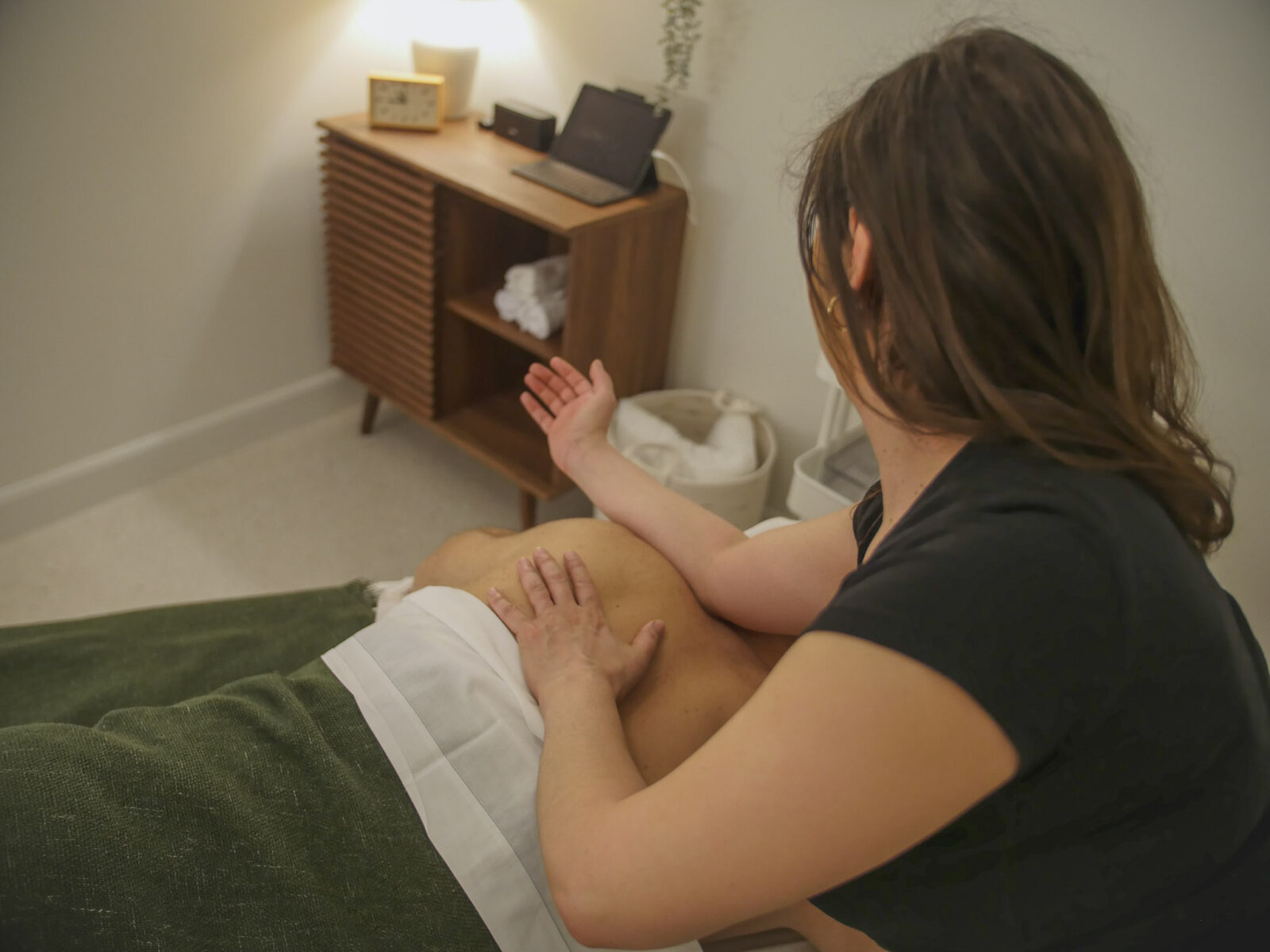
Neck and shoulder tension is the single most common reason Torontonians book with an RMT. It is not hard to understand why. Most people spend eight or more hours per day at a screen. Add the forward-flexed posture of commuting, carrying bags, and checking phones, and the cervical and shoulder girdle region carries sustained load for most of the waking day. By the time most people book their first appointment, the tension has been building for months. It has typically produced secondary symptoms like headaches, jaw tightness, and arm heaviness that they have been managing on their own.
This article explains the biomechanics of why neck and shoulder tension develops, which muscles are most commonly involved, how a Registered Massage Therapist approaches the complaint, and what you can realistically expect from treatment.
Why Does Neck and Shoulder Tension Develop?
The cervical spine is an engineering compromise. It supports the weight of the head while allowing a remarkable range of motion. However, it does so at the cost of vulnerability to postural load. The average adult head weighs between four and five kilograms. In a neutral spine, the deep cervical flexors and cervical extensors share this load efficiently. As the head shifts forward, the effective load on the cervical extensors increases dramatically.
Most people position their head fifteen to thirty degrees forward of neutral for most of the working day. At fifteen degrees, the effective load on the cervical muscles approximately triples. At thirty to forty-five degrees, which corresponds roughly to looking down at a phone or a laptop, the load increases well beyond that. The cervical extensors, the upper trapezius, and the levator scapulae hold the head in this position. None of these muscles were built for sustained isometric loading across an eight-hour work day.
Additional contributors to neck and shoulder tension include stress-driven shoulder elevation, asymmetric bag carrying, poorly positioned monitors, sleeping positions that place the cervical spine in sustained rotation, and jaw clenching or bruxism. Each of these adds to the cumulative load the cervical region carries every day.
The Symptom Picture: What Neck and Shoulder Tension Feels Like
The presentation is often broader than people expect. Most clients describe some combination of the following:
- A deep, dull ache at the base of the skull or across the upper trapezius that returns reliably by mid-afternoon.
- Morning stiffness that makes turning the head or looking over the shoulder feel restricted.
- Tension headaches that begin at the back of the head and travel forward to the temples or behind the eyes.
- Heaviness, aching, or intermittent tingling in the arm, typically from the shoulder to the elbow.
- Clicking or crunching sounds when moving the neck, particularly in rotation.
- Jaw tightness or soreness that is worse in the morning.
- Difficulty sleeping comfortably because no position feels fully supportive.
If your neck tension comes with frequent headaches, our article on massage therapy for headaches and migraines explains the mechanism and treatment approach in detail. If jaw symptoms are a significant part of your presentation, see our massage therapy for jaw pain page and our TMJ dysfunction treatment service.
Which Muscles Are Involved?
Upper Trapezius
The upper trapezius is the most commonly overloaded muscle in the neck and shoulder region. It runs from the base of the skull and the cervical vertebrae to the clavicle and the acromion of the shoulder blade. Forward head posture and stress-driven shoulder elevation load it heavily throughout the day. Active trigger points in the upper trapezius refer pain up the lateral neck and into the temple. This produces the classic tension headache pattern that millions of people manage daily with analgesics rather than treating the source.
Levator Scapulae
The levator scapulae runs from the upper four cervical vertebrae to the superior angle of the scapula. When it is chronically shortened, it creates a deep, specific ache at the upper inner corner of the shoulder blade. Many people describe this as the spot that never goes away. It also restricts cervical rotation, particularly when turning the head toward the affected side.
Suboccipitals
The suboccipital group is a set of four small muscles at the base of the skull. They connect the first two cervical vertebrae to the occiput and control fine head position. Forward head posture loads them heavily, especially when the eyes direct downward toward a screen. Active trigger points in the suboccipitals generate a headache that wraps over the top of the skull and behind the eye. Many people mistake this pattern for a migraine. Releasing the suboccipitals is one of the most reliable ways to reduce chronic tension headache frequency.
Scalenes
The scalenes are three muscles on the lateral neck that assist in cervical rotation and rib elevation during breathing. Forward head posture forces them to work harder to stabilise the cervical spine. Therefore, they frequently become overloaded. Active trigger points in the scalenes refer pain and tingling into the chest, shoulder, arm, and hand. This pattern is sometimes confused with thoracic outlet syndrome or carpal tunnel syndrome.
Rhomboids and Mid Trapezius
The rhomboids and mid trapezius retract and stabilise the shoulder blades. In a forward-rounded posture, these muscles stay in a lengthened and relatively weak position. They often feel painful between the shoulder blades. However, this pain is usually a consequence of the pattern rather than its primary driver. Treating the rhomboids in isolation, without addressing the shortened pectorals and cervical extensors, rarely produces lasting results.
How a Registered Massage Therapist Treats Neck and Shoulder Tension
Assessment Before Treatment
At Myocare, every neck and shoulder session begins with a structured intake and postural assessment before any hands-on work starts. Your RMT will observe your sitting and standing posture and assess your active range of motion in the cervical and thoracic spine. They will also palpate the relevant muscle groups to identify which are most restricted, which contain active trigger points, and whether fascial components are driving the complaint. This assessment is what separates clinical RMT care from massage as a comfort service. If you want to understand more about what makes a registered clinical provider different from an unregulated provider, our article on RMT vs non-RMT massage covers this clearly.
Hands-On Treatment
Treatment of neck and shoulder tension typically combines several approaches within a single session:
- Direct massage of the involved muscles using firm, sustained pressure to reduce baseline tension and improve local circulation.
- Trigger point release for active contracture sites using sustained pressure to allow the contracture to release.
- Myofascial work along the cervical and upper thoracic fascia to address the connective tissue layer that holds the muscular restriction in place.
- Gentle mobilisation of the cervical and upper thoracic joints where restricted mobility contributes to the muscular overload pattern.
Your RMT will typically also work on the thoracic extensors, the rib cage, and often the pectorals and anterior shoulder. This is not peripheral to the neck complaint. Thoracic stiffness and pectoral shortening are primary drivers of the forward-rounded posture that creates cervical overload. Treating the neck without addressing these contributing factors produces shorter-lasting results.
You can read more about myofascial release therapy and trigger point therapy in our dedicated articles.
Neck and Shoulder Massage at Myocare Toronto and Leaside
Myocare treats neck and shoulder complaints at our Annex clinic at 1096 Bathurst Street and our Leaside clinic at 1517a Bayview Ave, East York. Our Leaside location is particularly accessible for clients in Leaside, Davisville, Moore Park, and the Bayview corridor. If your presentation involves significant headaches, TMJ symptoms, or arm referral, mention this when booking. Our admin team will match you with a practitioner who has specific experience in those areas. You can review our team of practitioners before booking. Book online or call our Leaside clinic at (416) 265-9606.
How Many Sessions Does It Take?
Tension that has accumulated over months does not resolve in a single session. The first session typically produces a noticeable release and a meaningful reduction in symptom intensity. Subsequent sessions build on this progressively. Most clients with chronic neck and shoulder presentations reach their treatment goals within four to six sessions. After that, maintenance sessions every four to eight weeks prevent re-accumulation.
Clients who change nothing about their work setup or daily posture tend to need more frequent maintenance. Those who make ergonomic adjustments alongside their treatment tend to hold their results longer. Your RMT will discuss this with you and can provide specific postural recommendations.
Frequently Asked Questions
Can massage make neck tension worse?
Temporary soreness after treatment of chronically tight tissue is normal and expected. It typically resolves within 24 to 48 hours. If your symptoms worsen significantly, or if you develop new neurological symptoms such as numbness, tingling, weakness, or loss of grip strength after a session, contact your healthcare provider promptly.
What is the difference between neck muscle tension and a pinched nerve?
Neck muscle tension refers to muscular and fascial restriction in the cervical region. It may produce local pain and referred headache. A pinched nerve involves compression of a spinal nerve root, typically producing radiating pain, numbness, or tingling into the arm. RMT treatment suits many muscular presentations and can help manage the muscle tension that accompanies nerve-related complaints. However, your RMT will refer you if your presentation suggests nerve compression that requires further assessment.
Is neck and shoulder massage covered by insurance in Ontario?
Yes. RMT treatment for neck and shoulder complaints is covered under most extended health benefit plans in Ontario. Myocare offers direct billing to most major insurers at both our Annex and Leaside locations.
Can I get a neck massage if I have a disc injury?
Many clients with cervical disc injuries benefit from adapted RMT treatment. The approach needs significant modification to avoid techniques that increase intradiscal pressure or irritate the affected nerve root. Always disclose your full history at intake so your RMT can plan accordingly and refer you if needed.
How does stress contribute to neck tension?
Psychological stress activates the sympathetic nervous system and raises muscle tone throughout the body. The neck, shoulders, and jaw carry most of this increase. Regular massage therapy interrupts this pattern effectively. It activates the parasympathetic nervous system and reduces the baseline tone that chronic stress accumulation creates.