
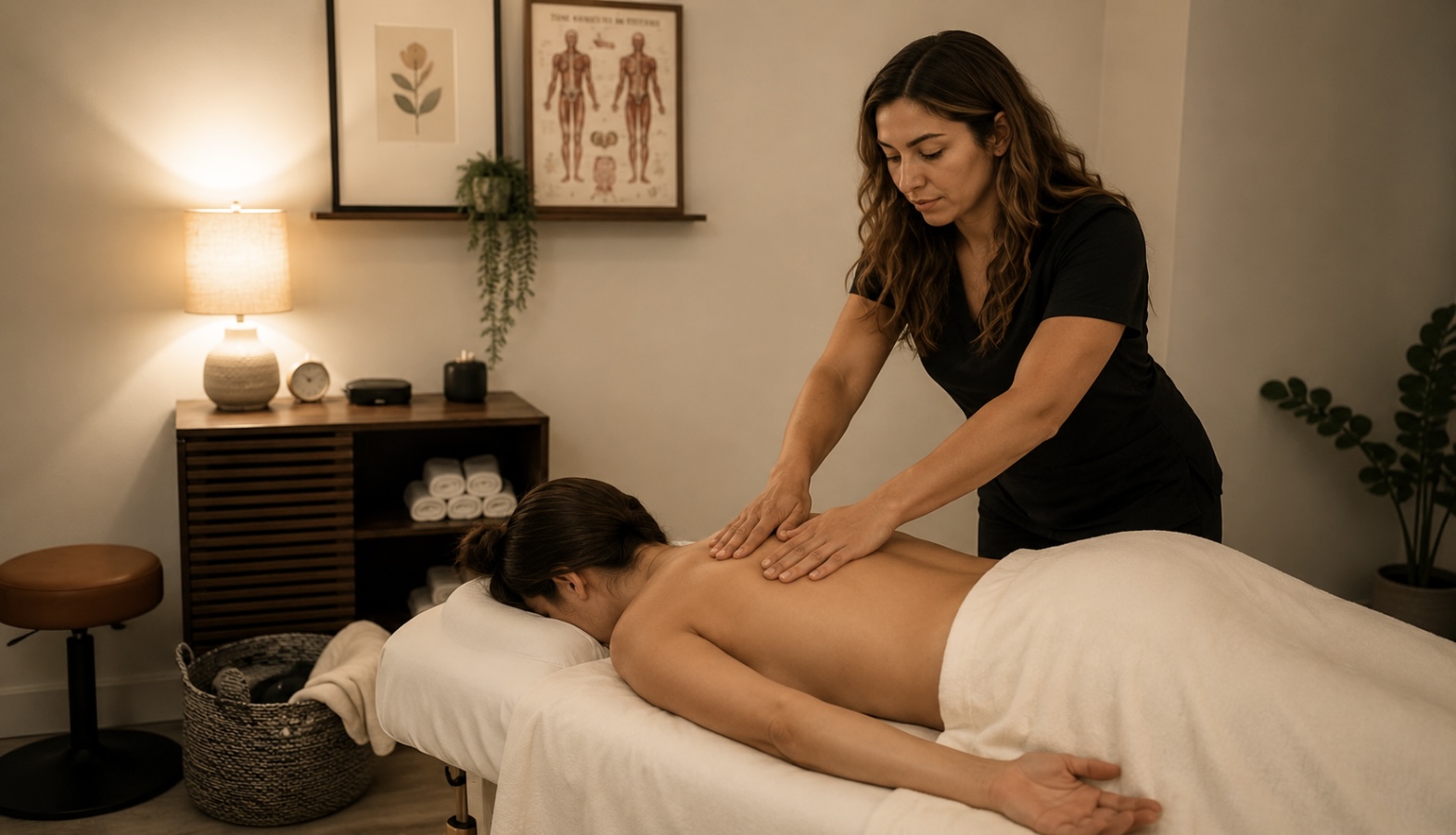
Whether you run along the Beltline Trail, cycle through the Don Valley, train at a gym in Leaside, or play recreational hockey twice a week, your body accumulates load between sessions. That load does not disappear with a rest day. It builds. Over weeks and months of consistent training, tension patterns develop in the tissue, range of motion decreases, and the risk of overuse injury climbs quietly in the background. Sports massage is one of the most effective tools available for managing that accumulation before it becomes a problem.
This guide explains what sports massage actually involves, who it is right for, how it differs from regular massage therapy, and what a session at Myocare looks like from start to finish.
What Is Sports Massage?
Sports massage is a targeted form of registered massage therapy designed for people who are physically active. It is not a relaxation treatment. The goal is to address the specific demands your activity places on your body — the muscle tension patterns that develop from repetitive movement, the fascial restrictions that accumulate from sustained training load, the adhesions that form in tissue recovering from minor strain, and the compensatory patterns that develop when one area of the body has been working harder than intended.
At Myocare, sports massage is performed by Registered Massage Therapists with training in athletic rehabilitation and movement assessment. Sessions are assessment-led, not protocol-driven. Your RMT evaluates your posture, your movement patterns, and the areas of the body carrying the most stress before deciding where and how to work. You can review our full sports massage and athletic rehabilitation service and browse our services and rates page for current pricing and session lengths.
Sports massage draws from a range of techniques including deep tissue massage, myofascial release, trigger point therapy, and stretch-based work. A session integrates whatever combination of these is most appropriate for your presentation that day. Therefore, it is not a fixed protocol but a responsive clinical approach.
Who Benefits From Sports Massage in Toronto?
Sports massage is not reserved for competitive athletes or elite performers. It is equally valuable for recreational runners, gym-goers, cyclists, swimmers, dancers, weekend hockey players, and anyone whose work or lifestyle involves repetitive physical demands. The common factor is not performance level but physical load.
Common presentations our RMTs treat with sports massage techniques include:
Delayed onset muscle soreness that lingers longer than expected and limits your ability to train consistently. IT band tightness and lateral knee pain in runners and cyclists, particularly those increasing mileage without sufficient recovery. Hamstring and glute tension from cycling and running gait patterns, especially in clients who sit for most of the working day. Rotator cuff and upper back strain from swimming, climbing, or sustained overhead pressing in the gym. Calf tightness and plantar fascia stress in runners carrying high weekly mileage. Hip flexor and quadriceps load from sports involving sprinting, lunging, or repetitive jumping. Lower back and SI joint compression from cycling posture or heavy lifting patterns that have not been adequately supported through soft tissue care.
If you are based in Leaside, East York, Davisville, or along the Bayview Avenue corridor, our Myocare Leaside clinic at 1517a Bayview Ave provides convenient access to regular sports massage without crossing town. For Annex and midtown clients, our original clinic at 1096 Bathurst Street has been providing sports-focused RMT care since 2010.
Sports Massage vs Regular Massage: What Is the Difference?
The distinction matters if you are deciding what to book. Both sports massage and regular registered massage therapy are performed by Registered Massage Therapists and both are covered by most extended health benefit plans. However, the focus, the assessment process, and the techniques used are different.
| Sports Massage | Regular RMT Massage |
| Movement and posture assessment before treatment | Health intake focused on symptoms and comfort |
| Firm, targeted pressure on athletic tissue | Variable pressure based on client preference |
| Active and passive stretching integrated throughout | Primarily hands-on soft tissue work |
| Goal: performance, recovery, and injury prevention | Goal: pain relief, relaxation, and general wellness |
| Focus on sport-specific demand areas and compensatory patterns | Full-body or complaint-driven focus |
| Aftercare typically includes exercise or mobility recommendations | Aftercare focused on hydration and rest |
In practice, the boundary between sports massage and regular therapeutic massage is fluid. Many clients who describe themselves as recreational rather than serious athletes benefit enormously from a sports-focused approach simply because it addresses the root cause of their tension rather than just relieving the surface symptom.
The Benefits of Sports Massage
Faster and More Complete Muscle Recovery
Training creates micro-damage in muscle fibres as a normal part of adaptation. Your body repairs this during rest, but accumulated tension, inflammation, and restricted blood flow can slow the process significantly. Sports massage increases circulation to fatigued tissue, reduces local inflammatory markers, assists lymphatic drainage, and helps the nervous system release the protective holding patterns that develop after intense effort.
Most athletes report that they can return to training sooner and with less residual soreness when they maintain a regular sports massage schedule. Furthermore, the cumulative effect of consistent sessions is measurably different from occasional treatment. The tissue quality improves over time rather than just temporarily feeling better after each visit.
Genuine Injury Prevention
This is arguably the most undervalued benefit of sports massage and the hardest to measure because the injury that was prevented leaves no record. Many overuse injuries develop slowly and predictably. A tight hip flexor that is not addressed becomes a strained iliopsoas. Restricted ankle dorsiflexion becomes plantar fasciitis six months later. Chronic upper trapezius tension becomes rotator cuff strain under load. Sports massage catches these restriction patterns early, before they reach the threshold of injury, and addresses them while the body is still functional.
Clients who book preventively rather than reactively tend to have significantly fewer training interruptions over a season or year than those who only seek treatment after something has gone wrong.
Improved Range of Motion and Movement Quality
Restricted range of motion limits performance and increases injury risk simultaneously. A runner whose hip flexors are chronically shortened will compensate with lumbar extension. A cyclist with restricted thoracic mobility will compensate through the neck and shoulder. These compensations create load in areas that were not designed to carry it. Sports massage addresses the muscle belly, the fascia, and the connective tissue at and around the affected joints to restore the movement capacity your sport requires.
Where restriction patterns are driven by fascia rather than muscle belly alone, your RMT may incorporate myofascial release techniques into the session. You can read about how myofascial release works and when it is most appropriate in our dedicated article.
Nervous System Recovery
The physical load of training is well understood, but the neurological load is often underestimated. Sustained high-intensity effort activates the sympathetic nervous system. Over time, athletes who do not adequately support their parasympathetic recovery accumulate fatigue that is not fully explained by muscle damage alone. Sports massage activates the parasympathetic response, reduces cortisol, lowers resting heart rate, and supports the neurological recovery that allows the body to adapt and improve between training sessions.
This is one reason many athletes feel subjectively better in training the day after a sports massage session, even before the tissue changes have fully consolidated.
Psychological Readiness
Regular bodywork keeps athletes connected to what their body is doing. Many clients report that sports massage helps them identify where they are holding tension before it becomes symptomatic, which in turn informs how they train and recover. That body awareness is a genuine performance asset, particularly for athletes who are prone to pushing through discomfort rather than addressing it.
What to Expect at a Sports Massage Appointment at Myocare
Intake and Movement Assessment
Your session begins with a structured intake that goes beyond a simple health history. Your RMT will ask about your training schedule, your recent load changes, your current complaints, what you have tried previously, and what you are hoping to achieve. They will then observe your posture and assess the movement patterns most relevant to your activity. This is not a formality. The assessment directly informs where the session spends its time and which techniques are most appropriate.
First-time clients should arrive five to ten minutes early and be prepared to describe not just where they feel pain but what they have been doing in the weeks leading up to it. Changes in training volume, new shoes, a different bike fit, an unaccustomed surface, or a recent race are all relevant.
The Treatment Itself
Sports massage uses firm, specific pressure on muscles and connective tissue. Expect deep, sustained work on target areas, pin-and-stretch techniques at adhesion sites, cross-fibre friction in areas of scar tissue or chronic restriction, and passive or active-assisted stretching integrated throughout rather than saved for the end. The pressure is adapted continuously to your tissue response, not applied at a fixed intensity from start to finish.
The sensation should be productively intense in restricted areas. It should not be sharp, should not cause you to brace or hold your breath, and should not feel random. Each technique should feel purposeful and connected to the complaint you described at intake.
Sessions typically run 60 to 90 minutes for most athletic presentations. Shorter 45-minute sessions can address a single region effectively if you are managing something specific.
Aftercare and Between-Session Recommendations
Your RMT will provide practical aftercare guidance at the end of your session. This typically includes hydration advice, relative rest for the treated areas, and specific mobility or activation exercises to reinforce the work done in session. Following these recommendations meaningfully extends the duration of benefit between appointments. Our pre and post massage care tips article covers general preparation and recovery advice in detail.
How Often Should Athletes Book Sports Massage?
Frequency depends on training volume, whether you are managing an active issue, and what phase of the training year you are in. General guidelines used at our clinic:
In-season training or high-volume training blocks: every one to two weeks. Off-season maintenance and general wellness: monthly or every three to four weeks. Active injury management during the early phase: weekly initially, tapering as the tissue responds. Pre-event preparation: within five to seven days before a key race, competition, or event, not on the day before. Post-event recovery: within 48 to 72 hours after a significant effort, when the inflammatory response has settled.
For athletes with recurring issues, combining sports massage with myofascial release or trigger point therapy within the same session often produces better outcomes than either technique alone. Your RMT will recommend the right combination based on what they find.
Sports Massage at Myocare Toronto: Two Locations
Myocare has two Toronto locations available for sports massage. Our Annex clinic is at 1096 Bathurst Street. Our Leaside clinic is at 1517a Bayview Ave, East York, convenient for clients in Leaside, Davisville, Moore Park, Thorncliffe Park, and the Bayview corridor.Book online or call our Leaside clinic directly at (416) 265-9606. If you want to find a practitioner with specific athletic experience, you can review our team of practitioners before booking.
Frequently Asked Questions
Is sports massage painful?
It can be intense in areas carrying significant restriction or tension, but it should not be sharp or unbearable. A well-executed sports massage session works at the edge of productive discomfort, not beyond it. Bracing against the pressure reduces the effectiveness of the work. Breathing through the intensity allows the tissue to respond. If you need less pressure at any point, say so clearly. Your RMT will adjust without question.
Is sports massage covered by insurance in Ontario?
Yes. Sports massage performed by a Registered Massage Therapist is covered under most extended health benefit plans in Ontario regardless of whether it is labelled as sports massage or therapeutic massage on the receipt. Myocare offers direct billing to most major insurers at both our Annex and Leaside locations. For a full explanation of how RMT insurance coverage works, see our article on massage therapy covered by insurance.
Do I need to be a competitive athlete to book sports massage?
No. Sports massage is appropriate for anyone who is physically active and wants to manage recovery, prevent injury, or address a specific musculoskeletal concern related to their activity. Recreational runners, gym members, cyclists, and active parents carrying children all benefit from this type of care. The techniques are adapted to what the tissue needs, not the performance level of the person.
How is sports massage different from deep tissue massage?
Sports massage is more movement-oriented and incorporates stretching and rehabilitation elements specific to athletic demands. Deep tissue massage is more broadly applicable to any chronic musculoskeletal complaint, not just athletic presentations. Both use firm, targeted pressure. You can read more about deep tissue massage in Toronto in our dedicated article.
Can sports massage help with a current injury?
It depends on the type of injury and the phase of tissue healing. Sports massage is appropriate for many soft tissue injuries once the acute inflammatory phase has passed, typically 48 to 72 hours after the initial incident. Your RMT will assess the presentation and determine whether massage is appropriate, whether a modified approach is needed, or whether you require a referral to another provider before starting manual therapy.
What should I wear to a sports massage appointment?
Wear comfortable, loose clothing that allows access to the areas being treated. Many athletes come in athletic shorts and a t-shirt or sports bra. Your RMT will use draping throughout the session. Tell them at intake which areas you want addressed and they will manage positioning accordingly.