
If you are looking for headache relief in Toronto, the most effective place to start is often not your head at all. Most headaches we treat at Myocare trace back to one or more of three overlapping sources: tight muscles with trigger points that refer pain into the head, restricted joints in the upper neck, and tension held in the jaw. Registered massage therapy in Toronto can address all three. As a result, many clients at our Annex and Leaside clinics find that treating the source of their headache produces relief that painkillers alone never did.
This article explains each of these three sources, how massage therapy treats them, and what your first headache-focused appointment at Myocare looks like. For a broader overview of headache types, including tension-type headaches and migraines, see our article on massage therapy for headaches and migraines.
Trigger Points That Refer Pain Into the Head
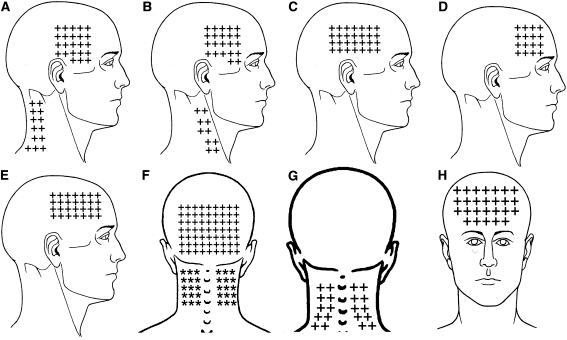
A trigger point is a tight, irritable knot in a muscle that refers pain somewhere else in the body, often nowhere near the knot itself. For this reason, the real source of a headache is frequently a muscle in the neck, jaw, or shoulders rather than in the head. Six muscles account for most of what we see clinically. Our article on trigger point therapy explains how trigger points form in more detail.
Upper Trapezius
Trigger points along the top of the trapezius, between the neck and shoulder, refer pain up the side of the neck, behind the ear, and into the temple. This is one of the most common contributors to one-sided tension headaches. Furthermore, desk posture and screen time frequently aggravate it, which is why we see this pattern so often in clients who work at a computer all day.
Sternocleidomastoid (SCM)
The SCM runs diagonally down the front of the neck and has two referral patterns depending on which division is involved. The sternal division refers pain deep into the eye socket, across the cheek, around the TMJ, and to the back and top of the head. In contrast, the clavicular division refers pain to the forehead, sometimes on both sides at once, as well as deep in the ear, behind the ear, and into the upper molars.
Suboccipitals
These small muscles sit at the very base of the skull, where the neck meets the head. Their trigger points refer pain in a band that wraps from the back of the head up and over to the temple and behind the eye. Many clients describe this pattern as a headache that “starts at the base of my skull.”
Temporalis
This fan-shaped muscle covers the temple. Its trigger points refer pain inside the head and through the temple itself, sometimes extending forward over the eyebrow. In addition, they can cause aching or sensitivity in the upper teeth.
Masseter
The masseter is the main jaw-closing muscle, and it refers pain differently depending on depth. Trigger points in its superficial layer refer to the eyebrow, upper jaw, and molars. Trigger points deeper in the muscle, however, refer into the ear itself. Consequently, the masseter is a frequent and often overlooked cause of unexplained earaches.
Splenius Capitis and Cervicis
These deep neck muscles refer pain to the vertex, the very top of the head. They can also project pain through to the eye on the same side.
The Neck Joints: Cervicogenic Headache
The top three joints of the cervical spine share a nerve pathway with the head itself. These are the joint where the skull meets the first vertebra, the joint between the first and second vertebrae, and the C2–C3 joint just below. The nerves that supply these joints (C1, C2, and C3) feed into the same relay station in the brainstem, the trigeminocervical nucleus, that processes pain signals from the face and head.
Because of this shared wiring, irritation or restriction in the upper neck joints can be felt as head pain, even though nothing in the head itself is the problem. This is called a cervicogenic headache. It typically presents as:
- A one-sided headache that starts at the back of the neck or base of the skull and wraps forward.
- Pain that worsens with certain neck movements or sustained positions, such as looking down at a phone or screen.
- A noticeably stiffer neck, with tight suboccipital, upper trapezius, and levator scapulae muscles.
For more on how we treat the cervical region, see our article on neck and shoulder massage in Toronto.
The Jaw: How TMJ Tension Drives Headaches
The jaw connects to the headache picture through the trigeminal nerve, the same nerve that supplies sensation to most of the face and head. Its lower branch serves the jaw and the jaw-closing muscles, including the masseter and temporalis. When those muscles are chronically overworked from clenching, grinding, or a jaw joint that is not tracking smoothly, that irritation travels back through the trigeminal nerve. As a result, it can sensitise the same pathway that drives tension headaches and migraines.
In practice, this means jaw tension rarely stays in the jaw. Instead, it shows up as temple pain, pain behind the eye, earaches with no ear infection, and headaches that are worse first thing in the morning. Morning headaches in particular are a common sign of nighttime clenching or grinding. Our article on TMJ massage in Toronto covers jaw dysfunction in detail, and you can also review our massage therapy for jaw pain service page.
How Massage Therapy Provides Headache Relief
Massage therapy addresses each of these three sources directly.
Releasing Trigger Points
Trigger points respond to sustained pressure, myofascial release, and stretching of the affected muscle. Deactivating a trigger point in the upper trapezius, SCM, or suboccipitals directly reduces or eliminates the pain it was referring into the head.
Easing Upper Neck Restriction
Neck joint restriction is rarely just a joint problem. More often, chronically tight suboccipital, levator scapulae, and upper trapezius muscles hold it in place by bracing around the joint. Releasing that surrounding tension restores normal neck mobility. In turn, it takes the mechanical strain off the upper cervical joints that were feeding into the trigeminocervical nucleus.
Treating Jaw Tension
Your RMT can treat jaw tension directly through extraoral and intraoral work on the masseter, temporalis, and pterygoid muscles. This eases the clenching pattern that keeps irritating the trigeminal nerve. At Myocare, RMTs with specific training in intraoral technique perform this work, and we always obtain your consent before any intraoral treatment begins.
Why Treating All Three Together Works Better
These three systems overlap and often reinforce each other. Tight jaw muscles pull on the neck. A stiff neck changes how the head sits, which in turn changes how the jaw muscles work. Therefore, treating all three together tends to produce better and longer-lasting relief than treating a headache as an isolated problem.
For headaches that are frequent, severe, or accompanied by other neurological symptoms, massage therapy works best alongside your physician or another regulated provider. It is not a replacement for medical evaluation. Many clients also combine massage therapy with acupuncture, which is available at both of our locations.
What Your First Headache Treatment at Myocare Looks Like
Your first visit applies the framework above to you specifically. Importantly, treatment for headache-related tension should not be painful. Good work in this area should feel soothing. The aim is to decrease muscle tension, improve mobility through the neck and jaw, and calm your nervous system, not to push through discomfort to force a release.
A Short Assessment
Before any hands-on work, your RMT checks your posture, neck range of motion, and jaw opening and movement. They then palpate the six muscles described above to find which trigger points are active and which ones reproduce your particular headache pattern. This usually takes 10 to 15 minutes and tells us exactly which structures to prioritise.
A Focused Treatment
The rest of the session goes directly to what the assessment found. This includes hands-on release of active trigger points, soft tissue work around the upper cervical joints to ease the muscular bracing that restricts them, and extraoral or intraoral jaw work if clenching or TMJ involvement is present. All of this stays at a pressure within your comfort. In other words, we treat the areas driving your headache, not a generic neck and shoulder routine.
Home Care
You will leave with a small, specific set of things to do between visits. This may include self-release or stretches for the muscles we worked on, posture or ergonomic adjustments if screen time or your desk setup is a factor, and guidance on heat, sleep position, or jaw habits where relevant.
A Treatment Plan
Based on how long you have had headaches and how your tissue responds, your RMT will talk through a plan with you. Typically, this involves more frequent visits at first, tapering as symptoms settle. We reassess at every session so we are always working toward getting you pain-free as efficiently as possible, and we adjust the plan if we are not seeing the progress we expect. Our guide on how often you should get a massage explains treatment frequency in more detail.
Massage Therapy for Headache Relief at Our Two Toronto Clinics
Headache-focused massage therapy is available at both Myocare locations, so you can get treatment close to home or work.
Massage Therapy in the Annex
Our Annex clinic at 1096 Bathurst Street serves clients across the Annex, Seaton Village, Palmerston, Christie Pits, and midtown Toronto. Book at our Annex clinic.
Massage Therapy in Leaside
Our Leaside clinic at 1517a Bayview Ave, East York serves clients in Leaside, Davisville, Moore Park, Thorncliffe Park, Flemingdon Park, and the Bayview corridor. Book at our Leaside clinic.
Registered Care and Direct Billing at Both Locations
Every session is performed by a Registered Massage Therapist regulated by the College of Massage Therapists of Ontario. In addition, we offer direct billing to most major Canadian insurers, so you pay only the portion your plan does not cover. To learn more, see our article on direct billing for massage in Toronto. If you would like to book with a practitioner who has specific experience with headaches or TMJ dysfunction, you can review profiles on our meet our practitioners page and mention your preference when booking.
Frequently Asked Questions About Headache Relief and Massage
Can massage therapy get rid of headaches?
For many people, yes. Tension-type and cervicogenic headaches often come from trigger points in the neck, jaw, and shoulders, or from muscular bracing around the upper neck joints. Massage therapy treats these sources directly, which can reduce how often headaches happen and how intense they are. Frequent or severe headaches should also be assessed by your physician.
Where should you massage to relieve a headache?
The most common areas are the base of the skull (suboccipitals), the top of the shoulders (upper trapezius), the front of the neck (sternocleidomastoid), the temples (temporalis), and the jaw (masseter). Your RMT finds which of these reproduce your headache during the assessment.
How many massage sessions does it take to help headaches?
It depends on how long you have had headaches and how your tissue responds. Most clients start with more frequent visits, often weekly, and taper as symptoms settle. Your RMT reassesses at every session.
Can jaw clenching cause headaches?
Yes. Clenching and grinding overwork the masseter and temporalis, which irritates the trigeminal nerve and can sensitise the same pathway involved in tension headaches and migraines. Morning headaches are a common sign of nighttime clenching.
Is headache massage covered by insurance?
Treatment by a Registered Massage Therapist is covered by most Canadian extended health plans, and Myocare offers direct billing to most major insurers. See our guide on whether massage therapy is covered by insurance.
Where can I get massage therapy for headaches in Toronto?
Myocare offers headache-focused registered massage therapy at two Toronto clinics: the Annex at 1096 Bathurst Street and Leaside at 1517a Bayview Ave, East York. Both offer direct billing.
Ready to treat the source of your headaches? Book with a Myocare RMT at our Annex clinic or our Leaside clinic.
Sources
- Cervicogenic Headache — Physiopedia
- Headaches and Migraines Related to Temporomandibular Disorders — Physiopedia
- Sternocleidomastoid Trigger Points: Masters of the Migraine — TriggerPointTherapist.com
- Temporalis Trigger Points and Referred Pain Patterns — TriggerPointSelfHelp.com
- Masseter Trigger Points and Referred Pain Patterns — TriggerPointSelfHelp.com
- Referred pain from trapezius muscle trigger points shares similar characteristics with chronic tension-type headache — PubMed
- Myofascial trigger points in the suboccipital muscles in episodic tension-type headache — ScienceDirect
- Clinical reasoning for manual therapy management of tension-type and cervicogenic headache — PMC